
How to travel to Antarctica.
Ship or fly-cruise, how long it takes, what you need to know before you book. From someone who was once young, figured out why every dollar is worth it, and has spent 20 years organizing expeditions for Spanish-speaking travelers.
Antarctica is the hardest continent on the planet to reach. Visiting it means joining an expedition that operates under the Antarctic Treaty — the international law that protects the continent and regulates all tourism there. Over 50,000 people visited in the 2019/20 season, and demand keeps climbing. This guide is the complete map: how to get there, what it costs, which ship to pick, when to go, what to pack, and what you'll see.
The difference from Patagonia comes down to one word: abundance. In Patagonia you see one or two glaciers — in Antarctica you'll get tired of counting them. In Patagonia you go looking for whales at Península Valdés — in Antarctica the humpbacks, the Minke whales, the orcas and the sperm whales come to you. You won't have to look for anything.
By Matias Puga · 20 years organizing expeditions to the white continent · ~50 Spanish-speaking travelers advised · Updated August 2026
From Ushuaia, crossing the Drake Passage (~48 h each way).
Classic Antarctic Peninsula cruise.
Depending on ship, cabin, and how early you book.
Austral summer. Outside that window, there are no expeditions.
How do you get to Antarctica?
90% of tourist expeditions leave by ship from Ushuaia, Argentina — the nearest mainland port, about 1,000 km away. Crossing the Drake Passage takes roughly 48 hours each way. The alternative that skips the Drake is the fly-cruise from Punta Arenas, which flies you straight to King George Island and saves you 4 days of sailing — but it costs a good deal more and depends heavily on weather.
| Option | Total length | Estimated cost | Who it's for |
|---|---|---|---|
| Ship from Ushuaia | 10–22 days | USD 6,000–25,000 | The vast majority of travelers |
| Fly-cruise from Punta Arenas | 6–8 days | USD 12,000–25,000 | Short on time, or prone to severe seasickness |
| Flight to the interior | Variable | USD 30,000+ | Adventurers / extreme athletes |
| Overflight from Australia | 1 day | USD 900–7,500 | No more time available, no landing |
| Cruise from New Zealand / Australia | ~4 weeks | High | Travelers with plenty of time |
My recommendation for most people: ship from Ushuaia. The most complete experience, the richest in wildlife, the best price-to-experience ratio.
Ship from Ushuaia
90% of tourist expeditions leave from Ushuaia, Argentina — the nearest mainland port to Antarctica, about 1,000 km away. It's the most popular option, the most affordable, and the one with the widest variety of ships and itineraries.
From Ushuaia, ships sail roughly 48 hours to reach the Antarctic Peninsula, crossing the Drake Passage. Most operators build in a free day in Ushuaia before departure — I recommend taking it. Beyond getting to know the city, it's insurance against flight delays. The ship waits for no one.
A critical tip almost nobody gives you: if you're arriving in Ushuaia with a connection through Buenos Aires, try to book both flights on the same airline. If your international flight arrives late and you miss the domestic connection, you'll only get automatically rebooked if you're flying the same carrier. With different airlines, you're on your own facing an already-paid-for Antarctic cabin.
Other departure ports exist but are minor: Punta Arenas (Chile) for fly-cruises and a few Falklands itineraries, Port Stanley (Falkland Islands) for long itineraries, and Buenos Aires or Puerto Madryn only for certain luxury cruises running very extended routes.
Do you have to cross the Drake Passage?
No. If you'd rather not cross it, the fly-cruise exists: you fly from Punta Arenas to the Chilean Frei base on King George Island, where the ship is waiting. You skip the 2 days of sailing in each direction, but the itinerary covers fewer days on the Peninsula and the price jumps to between 12,000 and 25,000 USD. For most travelers, the Drake is part of the experience — not an obstacle.
The concept behind the fly-cruise: you fly from Punta Arenas to the Chilean Frei base on King George Island, where the ship is waiting. The company running it is Antarctica21, with the Magellan Explorer. The itinerary covers the Peninsula over 4 to 5 nights on board.
The big wildcard is weather: the flight can be delayed hours or even up to 2 days, with weather windows as narrow as an hour. For this option you always need a flexible itinerary — you can't fly in with fixed, unchangeable return flights. The complex logistics of a special aircraft plus a ship waiting at the base is what explains the price: between 12,000 and 25,000 USD.
Don't want to read 8 pages? I've got the complete guide in PDF.
13 chapters: how to get there, choosing a ship, itineraries, packing, and the wildlife guide covering 28 species. 10 USD, instant download.
How long is a typical trip to Antarctica?
A classic cruise from Ushuaia runs 10 to 12 days: 2 sailing the Drake south, 5 to 6 exploring the Peninsula, and 2 heading back. The longer itineraries, which add the Antarctic Circle or South Georgia and the Falklands, stretch to 18-22 days. The fly-cruise, by skipping the Drake, wraps up in 6 to 8 days.
If your goal is the interior of the continent — the South Pole, the Vinson Massif (Antarctica's highest peak, at 4,892 m), ski expeditions to the pole — you need to fly. There are no airports, just runways on ice or compacted ground, and fewer than 500 people a year travel into the Antarctic interior. ALE flies from Cape Town, ANI departs from Punta Arenas. The cost runs past 30,000 USD. One unique advantage of this route: the chance to see Emperor penguins in their natural interior habitat, something Peninsula cruises rarely manage.
For those who want to see Antarctica without days at sea, there's the overflight: a charter flight from Australia (Melbourne, Sydney, Perth) that flies over the continent and returns without landing — 12 hours round trip on a Boeing 747, with experts on board. What it doesn't have is real contact: you don't land, you don't smell the polar air, you don't hear the Antarctic silence. It costs between 900 and 7,500 USD depending on the seat, and it only departs from Australia.
There are also expeditions departing from Hobart (Australia) or Invercargill (New Zealand), with a crossing of about 7 days — against 2 from Ushuaia — rougher seas, trips averaging 4 weeks, and less wildlife than on the Peninsula. Most Australian and New Zealand travelers still prefer flying to Ushuaia to depart from there.
Why every trip runs through the Antarctic Treaty
Antarctica has no government of its own. No country owns the continent, and that's exactly why tourism there is so tightly regulated: 56 countries that signed the Antarctic Treaty (1959) protect the region and delegate oversight of commercial tourism to IAATO, the International Association of Antarctica Tour Operators.
In practice, this means every ship operating commercially follows strict protocols: a maximum number of passengers ashore at once (100 people per site, no more), minimum distances from wildlife, boot and outerwear disinfection between landings so seeds and pathogens don't travel from one site to another, and a total ban on touching or feeding animals. It's not bureaucracy — it's what keeps Antarctica one of the few places on the planet that's still nearly untouched. When you pick an operator, the IAATO seal is your guarantee that all of this is being followed.
How I organize a trip to Antarctica
I've spent 20 years coordinating expeditions, mainly for Spanish-speaking passengers — a minority group on these ships, but one that always makes itself heard. This is the order I follow with every client.
-
01
Pick your season
November for untouched scenery and penguin courtship, December-January for chicks and endless daylight, February-March for whales and the best price-to-experience ratio. See the month-by-month breakdown.
-
02
Choose how to get there
Ship from Ushuaia (the vast majority) or fly-cruise from Punta Arenas if you'd rather skip the Drake.
-
03
Choose the ship and itinerary
Ship size defines the quality of your landings. See how to choose a ship and the 13 possible itineraries.
-
04
Book ahead
Expedition ships sell out 6 to 12 months ahead for the best cabins and prices. See what it costs and how to pay less.
-
05
Pack the right technical gear
Layering system, rubber boots, polar-climate accessories — not the gear you'd pack for a Patagonian trek. See the complete checklist.
-
06
Get the right travel insurance
Mandatory under the Antarctic Treaty, and it needs medical evacuation coverage specific to the region — not just any travel insurance will do.
The rest of the planning guide
Each piece on its own page, with the same tables and data I use with my clients.
What it costs
Real ranges by ship and cabin type, and the 4 strategies for paying less.
When to visit
Month by month, November through March: weather, wildlife, and prices.
How to choose a ship
Size, operator type, the IAATO seal, and every ship operating today.
The 13 itineraries
From the classic 10-day trip to the Antarctic Circle.
What to pack
The complete checklist — layering system, boots, accessories.
The Drake Passage
What to expect, medications that work, and the cabin tip nobody tells you.
Wildlife guide
7 whales, 7 seals, 7 penguins, 7 seabirds — what you'll see and when.
You've got the information. Now comes the deciding.
Which ship, which itinerary, which season, how to book without middlemen. Pick the level of support you need.
Complete guide in PDF
All 13 chapters with full detail. Self-service, 10 USD, instant download.
Buy the guide →1:1 Consulting
60-minute video call + complete itinerary with booking links. 100 USD.
Plan with Matias →20 years organizing expeditions · ~50 Spanish-speaking travelers advised
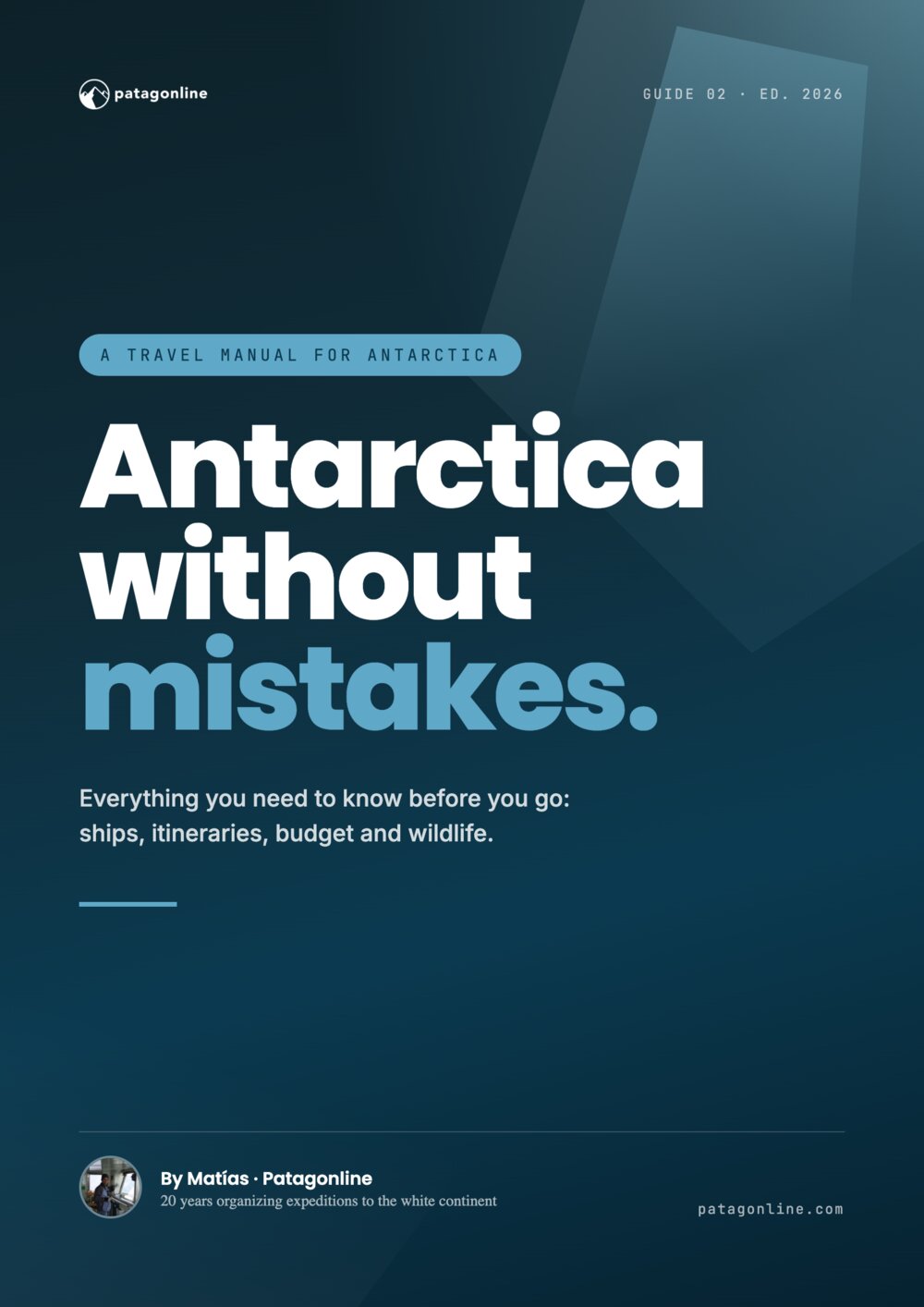
Antarctica without mistakes — the complete guide
30 pages: how to get there, choosing a ship, real costs, itineraries, and wildlife. A4 + mobile versions, instant download.
More from the Antarctica guide
- How much does a trip to Antarctica cost →Real ranges by ship type and the 4 strategies for paying less.
- When to visit Antarctica →Month by month from November to March, with weather and wildlife.
- How to choose a ship →Size, operator, the IAATO seal, and every ship operating today.
- The 13 itineraries →From the classic 10-day trip to the Antarctic Circle.
- What to pack →The complete technical gear checklist.
- The Drake Passage →What to expect and the cabin tip nobody tells you.
- Antarctic wildlife guide →28 species: whales, seals, penguins, and seabirds.